

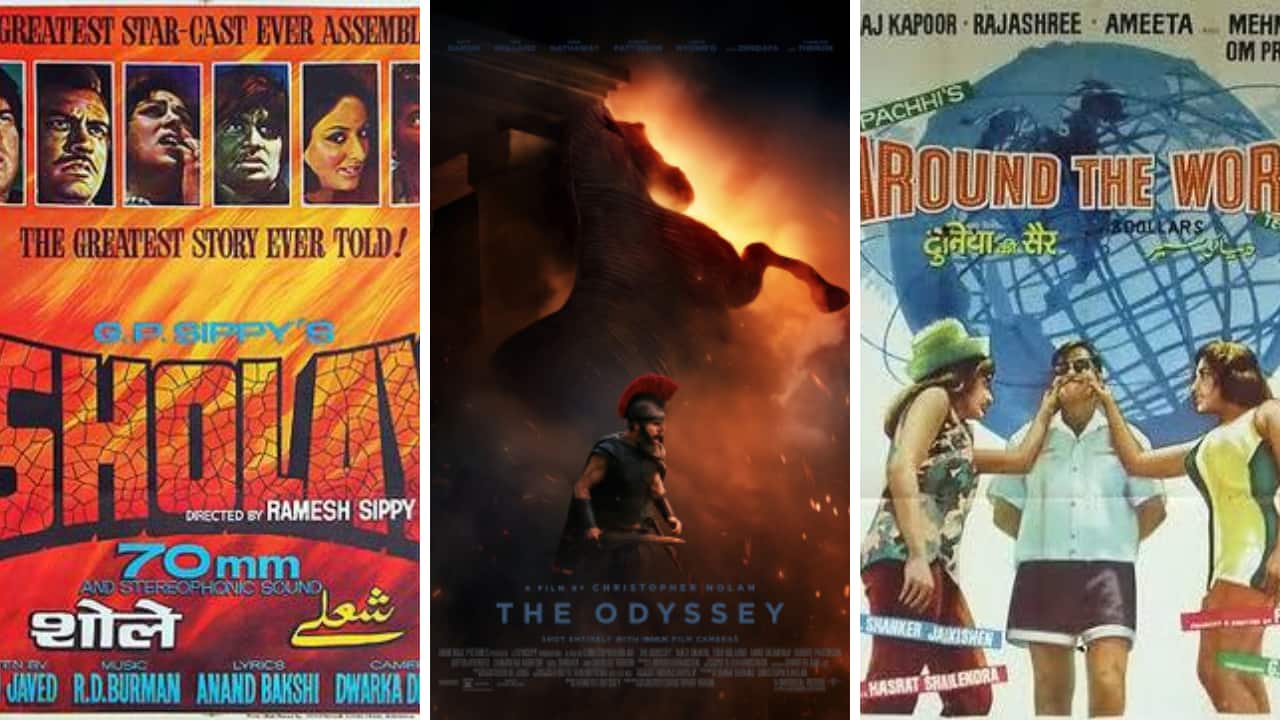
Today’s audiences often associate 70mm with Christopher Nolan, Quentin Tarantino. But India’s relationship with the format dates back nearly six decades with films like Around thw World and Sholay. Read to know the enti difference bwetetween the two formats.
Sarika Sharma
July 16, 2026 / 09:51 IST
Posters of Sholay, The Odyssey and Around the World.
- Nolan’s “The Odyssey” is first film shot entirely on IMAX.
- “Around the World” (1967) was India’s first 70mm film.
- Indian 70mm films were often 35mm blown up.
Liked this AI Summary?
Before The Odyssey: Do you know that Indian films like Sholay, Kranti and others brought 70mm to the big screen, but why Christopher Nolan’s movie is different
Oscar winning director Christopher Nolan has once again pushed the boundaries of filmmaking with The Odyssey, by shooting his new film entirely using IMAX film cameras – which makes it a first.
Now this achievement has actually sparked widespread discussions about 70mm filmmaking, and many in India are wondering whether the movies have entered a new technological era. But to your surprise, not many would know that India also has its own rich history with the 70mm format.
Long before IMAX became synonymous with blockbuster spectacles, Indian filmmakers had experimented with 70mm too in order to give the audiences a larger-than-life experience on the big screens. Classics in the 70s era like Around the World, Sholay, Shaan and Kranti were shot on 70mm.
But despite sharing the term ’70mm’, the technology used by our films in that era and the one used by Nolan in The Odyssey are entirely different.
India used 70mm decades before Hollywood
Today’s audiences often associate 70mm with Christopher Nolan, Quentin Tarantino. But India’s relationship with the format dates back nearly six decades.
In the late 1960s and throughout the 1970s and 1980s, filmmakers wanted the audiences to experience films on a scale much bigger than conventional cinema.
Large historical dramas, action entertainers benefited from the wider frame and richer image quality that was offered by 70mm screens.
Back then, watching a film in 70mm was considered a premium experience. Much like today’s IMAX screenings, audiences often travelled to watch movies in specific theatres that were actually equipped to project the format.
The film that introduced India to 70mm
And not many would know that it was Showman Raj Kapoor’s Around the World, released in 1967, which was India’s first Hindi film associated with the 70mm format.
Directed by Pachhi, Around the World was an ambitious film that featured extensive shooting in international locales at a time when overseas filming was rare for Indian filmmakers. Its colourful visuals, beautiful foreign locations, elaborate song sequences were perfect to be showcased on 70 mm screens.
Although the film was not a huge commercial successes, it still remains an important milestone in Indian film technology since it introduced the film lovers to the possibilities of large-format cinema.
Why Sholay became India’s biggest 70mm example?
If one film that is synonymous with 70mm in India, it was undoubtedly Ramesh Sippy’s Sholay (1975). The Amitabh Bachchan, Dharmendra, Hema Malini and Amjad Khan starrer transformed the idea of spectacle in Indian cinema.
The vast rocky landscapes of Ramgarh, Gabbar Singh’s dramatic introduction, the train robbery sequence and the action sequences looked grander on the huge screens. The film’s memorable run at Mumbai’s Minerva Theatre further cemented the association between Sholay and the 70mm format.
And above all the six-track stereophonic sound made the experience more enjoyable as it was something that the Indian audiences had not experienced until then. However, there is an important technical fact that is often overlooked.
Despite being remembered as a ’70mm film’, Sholay was not photographed on 70mm cameras. It was shot on conventional 35mm film but was later enlarged or in layman language – ‘blown up’ into 70mm prints for its theatrical release.
Following the enormous success of Sholay, many other Hindi films also received 70mm releases.
Here are some of the famous movies:
Several other Indian films during the 1980s and early 1990s also received 70mm prints, but only a handful of theatres across the country could actually screen them.
What 70mm meant for audiences in the pre-digital era
Before the rise of multiplexes in the early 2000s and advent of digital projection, it was 70mm that represented the highest level of cinematic experience for the movie goers.
But there is a misconception that Indian 70mm films are same as Nolan’s The Odyssey. Many may assume that because films like Sholay were released in 70mm, they were created using the same process as Nolan followed for The Odyssey.
That is not the same because as explained earlier in the article, many Indian movies were photographed by the directors using the normal 35mm cameras but their negatives were later enlarged during the post-production to create a 70mm print for the theatres. And this was called a 70mm blow-up.
Christopher Nolan’s The Odyssey changes the equation completely
But Christopher Nolan has in fact adopted an entirely different approach. Instead of enlarging a smaller image later, every single frame of The Odyssey has been captured by the director using IMAX film cameras.
And thus it becomes the first feature film to achieve this. It also means the extraordinary image quality begins at the moment of photography and not during the projection for theatrical exhibition.
The production reportedly used more than two million feet of IMAX 65mm film, with release prints presented in IMAX 70mm.
Unlike the conventional 70mm cameras, IMAX film will run horizontally through the camera using a 15-perforation frame hence creating an image that is dramatically larger than traditional 5-perforation 70mm film.
And the result is that there will be exceptional clarity, greater brightness and richer detail.
70mm vs IMAX 70mm: Same name but formats are completely different
Although both formats carry the ’70mm’ label, their technical specifications are different.
If we have to explain it in simple terms, it would mean that traditional 70mm makes the projection bigger whereas in IMAX 70mm the captured image itself is much larger and richer.
That distinction is what makes The Odyssey a landmark achievement in filmmaking rather than merely another film released in 70mm.
The Odyssey starring Matt Damon, Anne Hathaway, Tom Holland, Robert Pattinson, Lupita Nyong’o, Samantha Morton, Zendaya, and Charlize Theron, is going to release on July 17.
The film is directed by Christopher Nolan and produced by his wife Emma Thomas through their production company, Syncopy.
Sarika Sharma is Editor, Entertainment, MoneyControl.com. She has over 25 years of experience in the field of entertainment journalism.
first published: Jul 16, 2026 09:49 am
Discover the latest Business News, Sensex, and Nifty updates. Obtain Personal Finance insights, tax queries, and expert opinions on Moneycontrol or download the Moneycontrol App to stay updated!
Watch
Trending news

Microsoft executive laid off after 25-year stint; colleague calls him ‘most talented’
- Urban Company worker denied washroom after 3-hour job, gets 1-star rating: ‘Won’t have income for 5 days’
- Techie finds new job in Noida 15 days after being laid off from MNC: ‘It’s such a relief’
- Pakistani man pretends to be Indian, attempts to hug Chinese comedian on stage. Viral video sparks backlash
- Jamie Dimon on life after stepping down as JPMorgan CEO: ‘I’m not going to twiddle my…
- The Odyssey first reviews out: Christopher Nolan’s epic hailed as ‘once-in-a-generation’ spectacle
- Christopher Nolan’s The Odyssey gets just 30 true IMAX 70mm screens worldwide: India has none, one lab makes the $80,000 prints and only 90 people can run the projectors
- Her dream had no place in India, until she made one: How Avani Chaturvedi became 1st Indian woman to fly fighter jet solo & inspired millions of girls
- This boy cracked JEE Advanced at just 14: Meet Yuvraj Singh Solanki, Hindi-medium student from UP who clears one of India’s toughest exams
- IRCTC new website beta version is now live with new streamlined design, updated menu and more
- Motorola Edge 70 Max review: Ticks most boxes
- 5 dazzling desi wedding outfit ideas featuring Janhvi Kapoor
- 7 places near Delhi within 4 hours to enjoy monsoon season with friends and family
- World Snake Day 2026: Meet 5 elusive snakes in India that can live for over 30 years
- Happy Rath Yatra 2026: Best 30+ Lord Jagannath wishes, greetings, quotes and WhatsApp status
`);
}
if(res.stay_updated){
$(“.stay-updated-ajax”).html(res.stay_updated);
}
}catch(e){ console.log(e); }
});
},2000); // Reduced from 8s to 2s for better Core Web Vitals (LCP/UX)
});
