
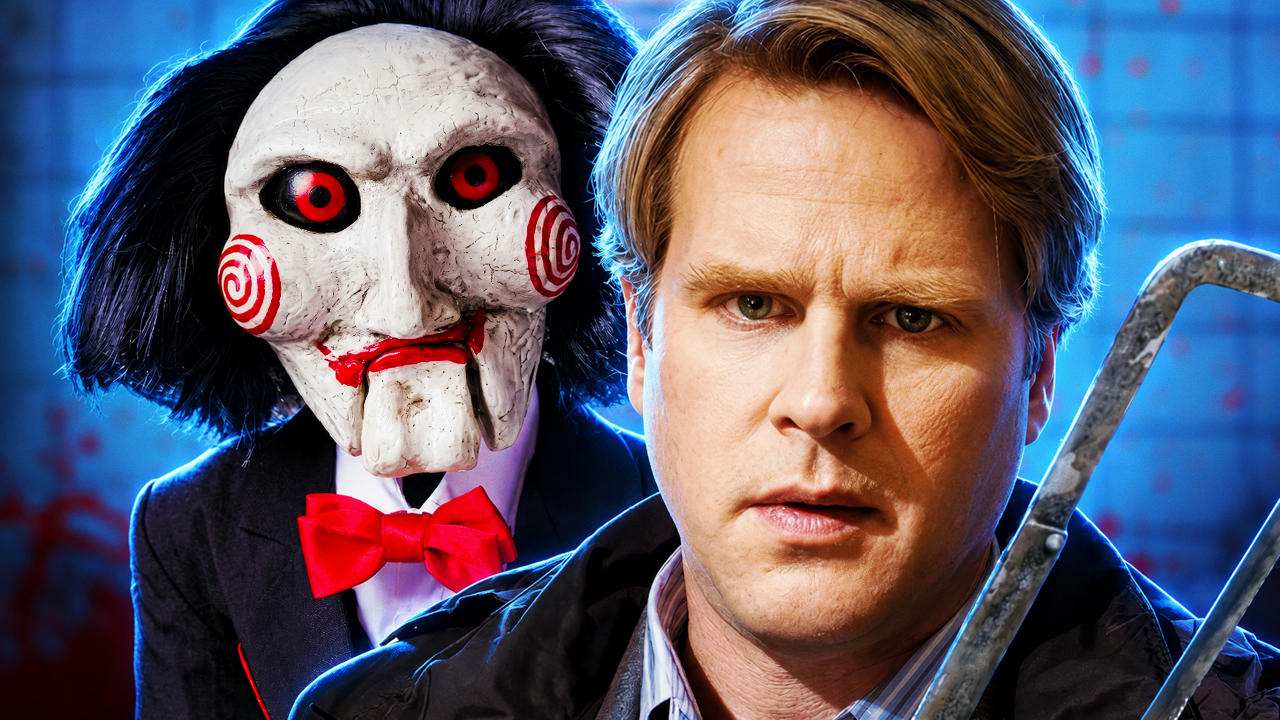
Whether it’s Friday the 13th Part 3, Freddy’s Dead: The Final Nightmare, or even Jaws 3-D, going into the third dimension feels like a rite of passage for many horror franchises. Sure, it’s a gimmick, but what type of film is better suited to having objects fly at the screen than horror? And despite being the planned final entry in the series, producers felt it was finally time for Saw to take the leap into 3D. Yet why was the original director fired just weeks before cameras were ready to roll? Why was the film converted from a two-parter into one movie? And why do we have traps taking place outside, of all places? Well, let’s find out all this and more as we look at what happened toSaw 3D.
The development of Saw 3D
Saw VII was announced before Saw VI had even been released, with the announcement coming in July 2009. While most films would wait for the previous installment to come out, allowing the filmmakers to gauge the audience’s reaction before deciding how to proceed, the Saw producers were already looking ahead.
The producers were shown a minute of footage from the original film converted to 3D and were convinced that the new sequel should take the leap into the format. However, the 3D element meant production would take longer, so work needed to begin as quickly as possible.
The writing team of Patrick Melton and Marcus Dunstan, who had worked on Saw IV, Saw V, and Saw VI, would return. Saw V director David Hackl was also set to return behind the camera.
Saw 3D was originally going to be two movies
At the time, ending a major franchise with a two-part finale was all the rage. It started with Harry Potter and the Deathly Hallows and continued with Twilight: Breaking Dawn and The Hunger Games: Mockingjay. It was a good way for studios to stretch out a story and, at least in theory, make twice the money. That was actually the original plan for Saw 3D. Unfortunately, the profits from Saw VI weren’t quite enough to justify splitting the story into two films, so the producers dropped the concept altogether. Most of the material intended for Part 2 was scrapped, with the intention of potentially using some of those ideas in future sequels if the series ever returned. So it seems they weren’t completely ignorant of the possibility that this might not actually be the end.
At various points, the movie was known as Saw: Endgame, Saw 3D, Saw 7, and Saw: The Final Chapter.
Why was David Hackl replaced?
The movie would run into a major hurdle right before filming began. Lionsgate had become concerned about the Paranormal Activity series, which executives believed had cut into the box office performance of Saw VI. Saw VI director Kevin Greutert was signed to direct Paranormal Activity 2, which would put that movie in direct competition with Saw 3D. So, being a bit shady, Lionsgate exercised a clause in Greutert’s contract that required him to leave Paranormal Activity 2 and take the director’s chair on Saw 3D instead.
This left David Hackl, who had been preparing the movie for months, out to dry. Fortunately for him, Hackl had a “pay or play” stipulation in his contract, meaning Lionsgate had to pay him his full fee.
Neither Hackl nor Greutert was particularly happy with the studio’s approach. Greutert was also anything but a “gun for hire.” He wanted to contribute creatively to the script, despite sets already being built based on the previous version of the movie. He would do a rewrite, but it still had to remain mostly within the confines of what had already been constructed.
The result can feel like a segmented, all-over-the-place story, with different creative minds pulling in different directions.
The challenges of shooting Saw 3D
David A. Armstrong, who had been the cinematographer on the previous six Saw movies, didn’t return. He was replaced by Brian Gedge, who had considerably less experience as a director of photography.
The movie used the brand-new SI-3D digital camera system, meaning the crew had to figure out the technology through trial and error.
Of course, Tobin Bell returned as Jigsaw/John Kramer, although his total screen time in the finished film amounts to only about three minutes. That feels like a wasted opportunity for what was supposed to be the final entry in the series.
Costas Mandylor also returned as Hoffman, Jigsaw’s protégé who has lost his way. Boondock Saints star Sean Patrick Flanery took the lead role of Bobby Dagen, while Final Destination alumni Chad Donella and Gina Holden appeared as Detective Gibson and Bobby’s wife, Joyce.
Just like the previous film, one role was cast through the reality show Scream Queens. Gabby West won the contest and earned the role of Kara. Unfortunately, she gets less to do than Tanedra Howard did in the previous movie. Gabby essentially gets about ten seconds of screen time and a car dropped on her.
Chester Bennington’s Saw 3D role
One of the coolest appearances, especially in retrospect, is that of Linkin Park’s Chester Bennington. Bennington was a massive fan of the Saw franchise and frequently saw the movies on opening day. Producer Mark Burg happened to move next door to one of Bennington’s bandmates, and the subject of Chester’s Saw fandom came up. The rest is history.
Bennington plays Evan, a skinhead who finds himself at the center of one of the movie’s most memorable traps. He even took acting lessons for the part because he took the role seriously.
Cary Elwes returns as Dr. Lawrence Gordon
We would also see the return of a massive star from the franchise’s past, with Cary Elwes reprising the role of Dr. Lawrence Gordon. There had long been speculation that Gordon was still alive, and Saw 3D finally confirmed it. The producers had actually tried to bring Elwes back before, but there had been friction between the actor and the production.
Elwes had filed a lawsuit over his salary from the first Saw and had turned down previous opportunities to return. Once the lawsuit was settled out of court, however, Elwes was happy to come back and reprise the role.
How Saw 3D was filmed in 3D
Filming on Saw 3D began in February 2010 in Toronto and wrapped in April. Given the success of My Bloody Valentine 3D, the producers wanted plenty of effects involving objects flying toward the camera. But they also wanted to add depth and make the audience feel like they were actually inside the traps.
The extra dimension helped push the movie’s budget to $17 million, the largest of the series at that point. Shooting in 3D also added roughly 10 days to production because properly aligning the cameras took considerably more time.
The filmmakers could have shot the movie traditionally and converted it to 3D in post-production, as many movies were doing at the time. Instead, they felt shooting in 3D would produce the best results.
3D requires a lot of light and can dull an image, which is why Saw 3D looks noticeably brighter than its predecessors. The new cameras also meant the crew had to learn on the go. Traditional 3D uses a two-camera setup, meaning the two images have to match despite being captured from slightly different positions. The lighting therefore had to be consistent between both cameras.
That meant no lens flares or hot spots, since they wouldn’t match between the two images. The filmmakers also didn’t have many lens options, leaving Greutert with a very limited palette with which to paint.
The story of Saw 3D
While most Saw movies begin with a glorious opening kill, Saw 3D opens with a reveal many fans had been waiting seven years for: the return of Lawrence Gordon. We see him immediately after the events of the first film, dragging himself across the floor after cutting off his own foot. There was no hiding his presence or saving the reveal for the end.
Then we finally get our opening kill, and it’s quite different from those in previous movies because it takes place completely in public and even in daylight. Two men are attached to a massive Saw device, with their girlfriend hanging high above them. They have to sacrifice one another in order to save her. Thankfully, they decide to be bros and not prioritize this cheater. The entire scenario, with members of the public watching through glass, was intended to represent public executions of old and society’s fascination with watching them.
Originally, John Kramer was supposed to be standing in the crowd watching the trap. This would have muddied the timeline somewhat, showing that Jigsaw had staged a public trap long before the audience realized it. However, once the story was condensed from two movies into one, scenes had to be shuffled around, putting the trap firmly in the present, when John was already dead.
Hoffman goes after Jill
If you’ll remember the end of Saw VI, Hoffman was placed inside a newly designed Reverse Bear Trap and severely injured. So we open on that, with Hoffman practically looking like Michael Myers or Jason Voorhees as he hunts down Jill Tuck.
We even get a fun fakeout where it seems like Hoffman has captured her and placed her in an unwinnable trap. It’s quite the brutal ending, but it all turns out to be a dream sequence. Though, if I were Jill, I’d probably have preferred that death to what she ultimately gets.
Bobby Dagen becomes Jigsaw’s target
The A-story of Saw 3D follows Bobby Dagen, a man going on a book tour to talk about surviving Jigsaw. The problem? He never actually survived one of Jigsaw’s games. He’s an obvious target for someone looking to teach him a lesson.
The B-story follows the pursuit of Hoffman, who has been exposed as Jigsaw’s apprentice, and his pursuit of Jill.
It takes a while before Bobby actually gets involved in a trap, so the film throws some random ones at us in the meantime.
Chester Bennington’s “Skin the Racist” trap
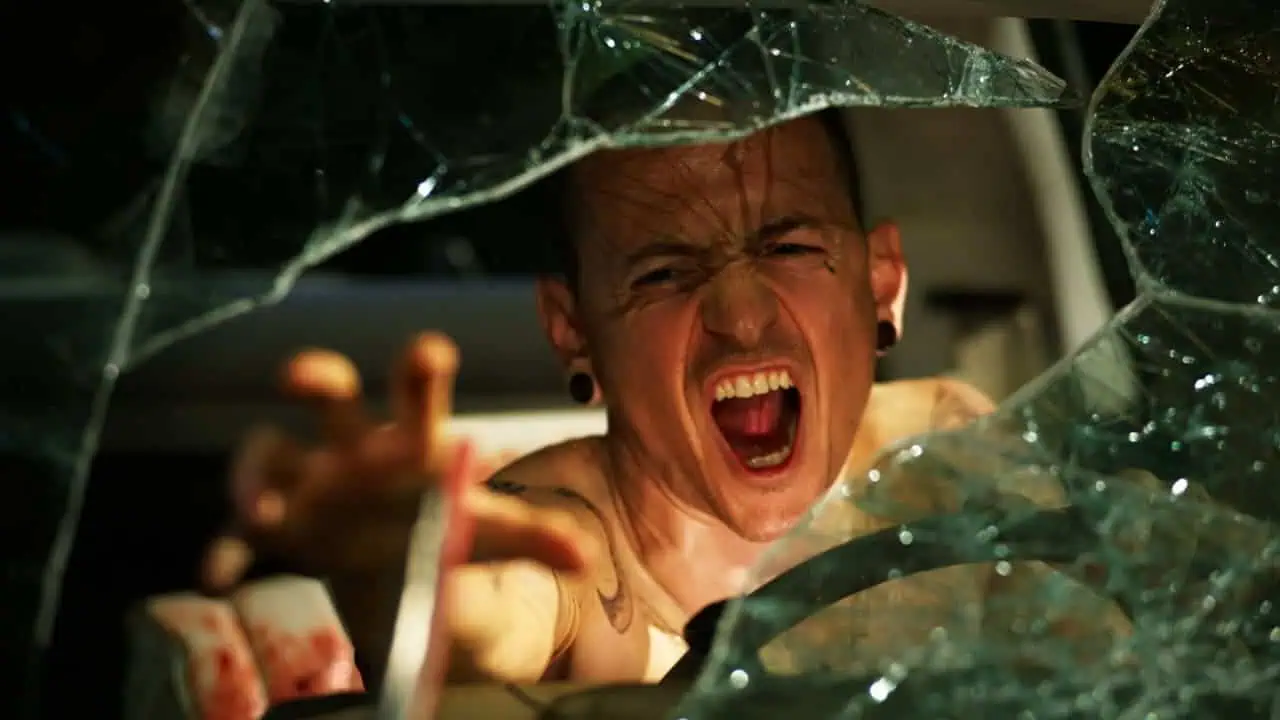
Chester Bennington appears as Evan, a skinhead whose body is glued to the seat of his car while three of his friends are locked in precarious situations outside the vehicle. He has to pull himself free and activate a lever. If he fails, the car will lurch forward, pulling the jaw from one person, smashing through another, and giving a third person a face full of tire. It’s pretty brutal.
This was originally intended to be the opening of the movie and was a trap the writers had been envisioning for years, calling it “Skin the Racist.” Producers repeatedly pushed back against it, calling it too violent, too disgusting, and simply wrong. They finally relented for the final outing.
Evan was originally intended to survive his trap, but Bennington had a tight schedule while touring with Linkin Park, so they weren’t able to film the scenes of Evan being taken to the hospital.
The Jigsaw survivors group
One of the cooler elements of the film is the Jigsaw survivors group. It’s a fun way to quickly remind us of previous traps while tying the movie into the larger franchise. The group includes Simone from Saw VI, Mallick from Saw V, and Tara, Emily, and Addy from Saw VI. Brad and Ryan from the opening trap are also there.
It’s a great way to connect Bobby’s fake survivor story to people who actually survived Jigsaw’s games.
Bobby’s game begins
Bobby is taken by Hoffman and told that he has one hour to save his wife, Joyce, or she will die a horrible death. John Kramer had apparently put a target on Bobby’s back years earlier.
The most memorable moment of the film is easily the one that became a meme. How do you make sure the audience knows someone is so much younger? A backwards baseball cap! This is the original “How do you do, fellow kids?” and it’s glorious. The scene does introduce a central theme of the film, though: an army spreading the word of its leader.
Bobby’s PR team is spreading his lies about overcoming Jigsaw, while Jigsaw’s followers are spreading Jigsaw’s ideals. Despite the recurring question of whether the victims really deserve what’s happening to them, there are some interesting thematic parallels.
Bobby’s setup is similar to the previous film, as he has to move from room to room while different members of his team are placed in traps. He then has to make some kind of sacrifice to save them.
Nina’s fish-hook trap
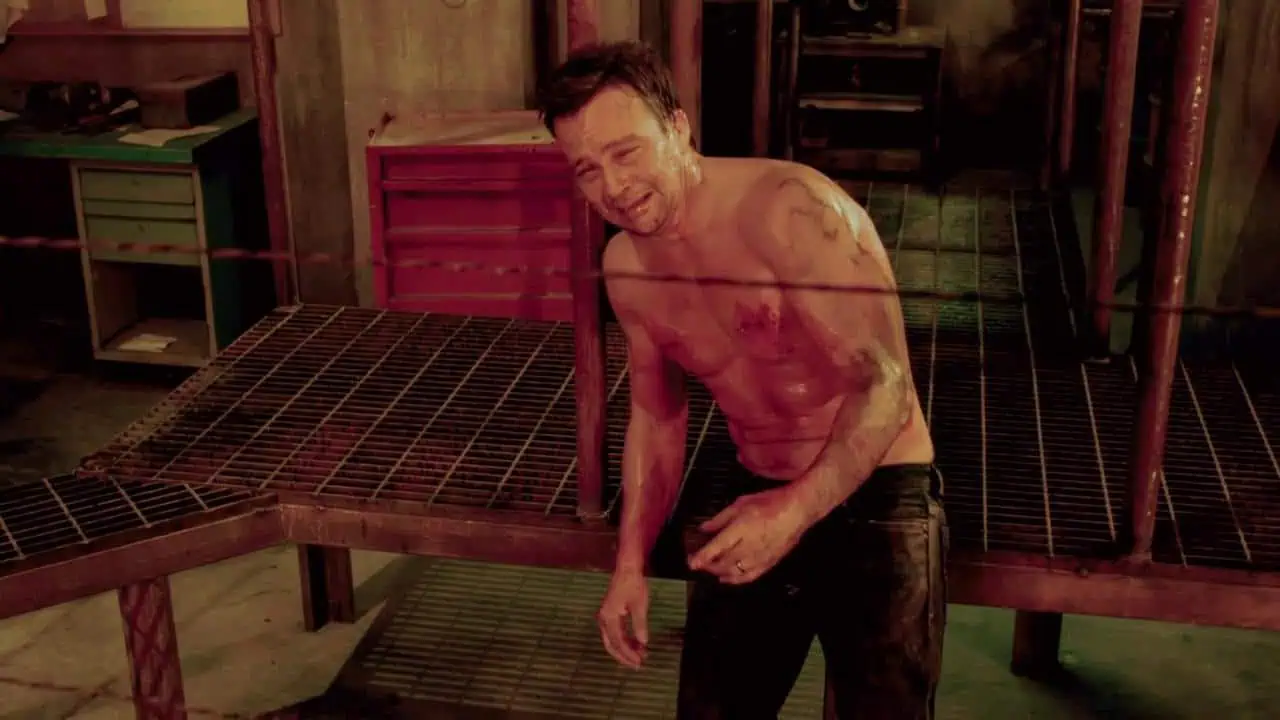
First up is Nina, Bobby’s public relations handler, whom Jigsaw accuses of helping spread Bobby’s lies. Bobby has to retrieve a key placed inside her stomach and attached to fish hooks. The device will push screws through her neck if the sound in the room reaches a certain decibel level. The trap was inspired by the Venus Fly Trap kill from Saw II, where a victim had to cut a key out of his own eye.
The whole thing is pretty tragic because Nina actually manages to get the key. She just runs out of time. Poor Nina.
Suzanna’s eye-and-mouth trap
Next up is Bobby’s lawyer, Suzanna, whom Jigsaw accuses of spreading lies while hiding from the truth. Her trap involves spikes that will pierce her eyes and mouth. Hilariously, Greutert actually suggested adding the spike that enters her mouth because he felt the two going into her eyes weren’t cruel enough. Oh, you sick bastard.
To get her out, Bobby has to lift weights for 30 seconds while simultaneously being stabbed in the ribs. As you can probably guess, Bobby can’t handle the pain, and Suzanna meets a brutal end. They had actually considered keeping her alive, but given the nature of the later traps, the filmmakers didn’t want another person tagging along with Bobby.
Though let’s be real: in a Saw where most of the victims don’t quite deserve their harsh fate, letting the lawyer off scot-free would have been a mistake. So bye-bye, Suzanna.
Cale’s hanging trap
Bobby’s third obstacle is easily the weakest. It features his friend Cale, who is blindfolded across the room. They both have to work their way toward a key, which they manage to reach, only for a bad exchange to get Cale killed.
He gets hanged, and it’s a pretty low-key kill for something like Saw. It may just be the weakest kill in the entire franchise.
Bobby’s teeth-pulling trap
The writers had wanted to do a “teeth pull” trap ever since the teaser poster for Saw III disturbed theatergoers. So there’s a moment where Bobby has to pull out his own teeth in order to reach the room where his wife is being held.
But that’s not the final trap. He actually has to recreate the trap that he claimed Jigsaw originally put him through, hanging himself from hooks in a setup straight out of Hellraiser. Otherwise, his wife dies.
And that leads us into our big finale.
The twists in Saw 3D
I won’t lie: there are some pretty dumb twists in Saw 3D. The first is the fact that Hoffman hides inside a body bag in order to get into the police station.
The whole storyline involving Detective Gibson is then unceremoniously scrapped of Saw 3D, because the moment is remarkably similar to one in Breaking Bad
It’s almost as pointless as the group of SWAT guys who nearly reach Bobby’s game, only to end up poisoned and killed.
Bobby fails his final test
To no one’s surprise, Bobby fails his game. We’ll just ignore the fact that he could have simply stepped onto the hooks and pulled himself up to release his wife. Instead, Joyce gets the prize of burning alive.
That’s right: the woman who did absolutely nothing wrong gets arguably one of the most brutal deaths in the franchise as punishment for someone else’s actions. Ouch.
Funnily enough, one of the notes from the producers after seeing the first cut was reportedly, “Can we have less of the burning woman?”
Hoffman kills Jill and goes after Dr. Gordon
Hoffman goes on an absolute rampage, even taking out the coroner who performed the autopsy on John’s body in Saw IV. He’s in full slasher form, taking out police officer after police officer. Who needs traps when you’ve got such a brutal killer instinct?
He does all of this so he can get to Jill Tuck. Poor Jill is placed in the original Reverse Bear Trap, and we’re finally able to see just how disgusting the effect would actually be.
For a moment, it seems like Hoffman is going to get away with it. But we know better than that.
Dr. Lawrence Gordon’s return explained
John had sent Lawrence Gordon a tape explaining what he needed to do if anything happened to Jill. Hoffman had lost his way, or had he ever found it in the first place? So Dr. Gordon was there to correct it.
Lawrence had been there since the beginning, helping Jigsaw with various traps throughout the franchise’s history. He sewed keys into eyes, sewed eyes shut, and did plenty more behind the scenes. He even made recommendations about potential victims.
If you’re wondering who the two mysterious people are standing with Gordon, the writers revealed during the commentary that they’re Ryan and Brad from the film’s opening trap.
And remember how I said Jigsaw was originally supposed to be watching that trap? Dr. Gordon would have been standing beside him, making it the first trap he’d witnessed since the events of the original Saw.
Hoffman is trapped in the original bathroom
Hoffman wakes up to find himself chained to the bathroom from the original film. It’s all come full circle. There’s even a fun moment where Dr. Gordon kicks the hacksaw out of Hoffman’s reach, a nod to how Gordon escaped the bathroom in the original Saw.
Hoffman is left to die in the bathroom. While obviously nothing is set in stone until it’s actually shown on screen, the writers have said he’s dead, so we’ll take that at face value until the moment it changes.
The release of Saw 3D
Saw 3D, also known as Saw: The Final Chapter and Saw VII, was originally scheduled to be released in the United States on October 22, 2010. However, Paranormal Activity 2 had already claimed that date, so Saw 3D was pushed back one week to October 29, 2010. The movie opened with $24.2 million domestically and ultimately earned approximately $136.2 million worldwide.
And, hilariously, in a mix-up that without a doubt cost some theater manager their job, a Showcase Cinemas location in Massachusetts accidentally showed Saw 3D rather than the intended film, Megamind. You can imagine how traumatized that young audience would have been.
Unfortunately, audiences who actually went to see the film on purpose may have wished they hadn’t. Saw 3D earned a 41% audience rating on Rotten Tomatoes, while critics absolutely hated it, giving the movie just 9%. The consensus was pretty simple: “Sloppily filmed, poorly acted, and illogically plotted, Saw 3D leaves viewers trapped in the most lackluster installment of the series.”
Saw 3D wasn’t the end of the franchise
Saw 3D was a rough note on which to try to end the franchise, so most fans are probably thankful that it wasn’t actually the end. We would eventually receive three more entries with Jigsaw, Spiral, and Saw X, each taking place at different points in the timeline. While the implication of past Jigsaw victims forming a new group is quite intriguing, it sadly hasn’t been taken advantage of to this point.
3D would never return to the series, and the format arguably took away much of the visual style that gave Saw its identity. While we did finally see the return of a franchise original, it may have been too little, too late.
And that, my friends, is what happened to Saw 3D.
A couple of previous episodes of this show can be seen below. For more, check out the JoBlo Horror Originals YouTube channel—and don’t forget to subscribe!
