
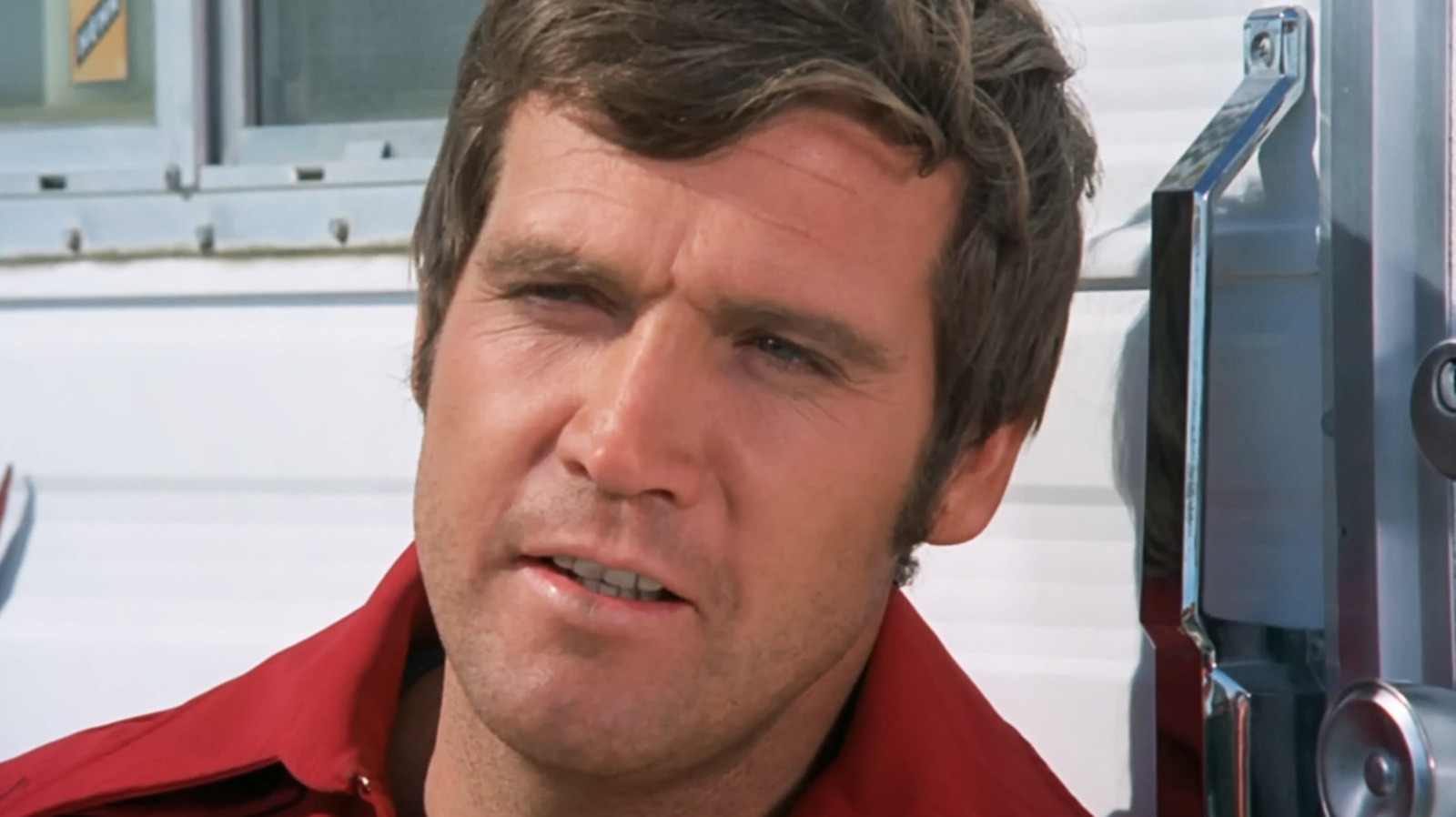
Before he was the Six Million Dollar Man or the Fall Guy, Lee Majors introduced himself to mass audiences as Heath Barkley on the classic Western TV series “The Big Valley.” But while he came to prominence as the hard-headed Barkley scion, Majors had actually been working in film and TV for some time and had worked alongside some of the greats. In 1968, for instance, he made his official movie debut in the oft-overlooked Western “Will Penney,” which starred Donald Pleasance, Bruce Dern, and the great Charlton Heston.
Majors actually made his film debut in the 1964 William Castle horror “Strait-Jacket.” Unfortunately he went uncredited for his contribution to the film. But it was a heck of a debut for the young star-in-the-making. For one thing, he was able to work with a horror legend in Castle, who six years prior had issued life insurance policies to viewers of his film “Macabre” in order to cover the possibility of them dying of fright during the movie. What’s more, Majors arrived on-screen in spectacular fashion when the great Joan Crawford hacked off his head.
After that, Majors made his TV debut in genre-defining Western series “Gunsmoke,” before guesting on an episode of “The Alfred Hitchcock Hour” and appearing alongside Elvis Presley in the 1967 musical comedy “Clambake.” Unfortunately, for his second film appearance, Majors’ name was once again absent from the credits. It was only when he appeared in “Will Penny” that the actor finally got his name on a movie.
William Penny was overshadowed by major Western movies of 1968
1968 was a great year for Westerns. Sergio Leone debuted “Once Upon a Time in the West” and fellow Italian filmmaker Sergio Corbucci delivered “The Great Silence,” one of the finest dark Western movies ever made. 1968 was also the year Clint Eastwood — having won over audiences as the Man with No Name in Leone’s “Dollars” trilogy — proved he was capable of leading an American Western with “Hang ‘Em High.” In a sense, then, Tom Gries’ “Will Penny” was always going to get lost on the shuffle.
Gries wrote and directed the film based on an episode he’d written for Sam Peckinpah’s series “The Westerner.” It wasn’t a bad idea to mine that particular series for movie inspiration. The revisionist Western movement had already gained momentum in 1968 and while “The Westerner” aired on NBC back in 1960, Peckinpah had infused it with a revisionist ethos, attempting to create a more adult Western series at a time when the white-hat-vs.-black-hat simplicity of the golden age still reigned supreme.
Gries’ episode was called “Line Camp,” and saw Brian Keith’s Dave Blassingame stumble across a dead man before taking his place in a cattle camp, where he clashes with an old acquaintance. “Will Penny” starred Charlton Heston as the titular cowboy, who similarly encounters a dead man on his travels and delivers his body to the nearby Flat Iron ranch. His eventual clash with old rivals, however, was much more consequential than Keith’s.
Will Penny is an excellent but overlooked late-’60s Western
In “William Penny,” Charlton Heston’s aging cowpoke is hired to patrol the outer limits of the Flat Iron Ranch, where he discovers Catherine Allen (Joan Hackett) and her son Horace Greeley “Button” Allen (Jon Gries) living in an abandoned cabin. He gives them a week to move. Soon, however, he’s beaten and left for dead by wandering outlaws “Preacher” Quint (Donald Pleasence) and his son Rafe Quint (Bruce Dern). Catherine helps nurse him back to health and the pair fall in love. But Will isn’t able to relax into his new life for too long.
Earlier in the film, we see Lee Majors’ Blue, one of Will’s fellow trail hands, who encounters Preacher Quint and his sons Rafe and Rufus Quint (Gene Rutherford). Will then rides in and guns down Rufus, leading to Preacher and Rafe’s revenge later in the film. Blue also returns during the climax to help Heston’s cowboy fight back against the murderous outlaws and rescue Catherine Allen and her son.
It was a significant role for Majors, who at that point was yet to receive a feature film credit. Alas, “Will Penny” remains a criminally overlooked late-1960s Western that was a fantastic showcase for Majors and every other actor who helped bring Tom Gries’ excellent script to life. It might not be remembered as one of Lee Majors’ best movies, but it’s certainly worth seeking out for fans of the genre and deserved much more attention than it got. Even Heston claimed to like “Will Penny” the best of all the projects he’d ever made — at least according to ABC News.
